

Emergency Locksmith Pricing Explained
Table of Contents
What Drives Emergency Locksmith Service Pricing
Service Call Fees vs. Labor Costs
Time of Day and After-Hours Surcharges
Residential vs. Commercial Lockout Fees
How to Spot a Locksmith Scam
Red Flags in Pricing and Communication
Verifying Credentials and Licensing
What to Ask a Locksmith Before They Arrive
Emergency Lockout Service Duration and Response Times
Understanding Your Invoice
Itemized Breakdown and Hidden Fees
Insurance and Warranty Coverage
Frequently Asked Questions
Last Updated: September 26, 2026
What Drives Emergency Locksmith Service Pricing
Understanding emergency locksmith pricing requires knowing the core components that make up your final bill. When you're locked out at midnight or facing a security breach, the cost reflects more than just the technician's time. Service call fees, labor rates, dispatch charges, and after-hours surcharges all stack together to create the total you'll pay.
Emergency locksmith pricing isn't arbitrary. It's built on legitimate business costs: technician training and certification, vehicle maintenance, insurance coverage, and the overhead of maintaining 24/7 availability. The difference between a standard appointment and an emergency call often justifies the premium you're charged.
Service Call Fees vs. Labor Costs
A service call fee is separate from labor costs. This is where confusion often starts. The service call fee, sometimes called a dispatch fee or trip charge, covers the locksmith's arrival at your location. It's a flat rate that exists regardless of how long the work takes. Labor costs, by contrast, are typically hourly or based on the specific job complexity.
Think of it this way: the service call fee gets the technician to your door. Labor costs are what you pay while they're working. A straightforward residential lockout might take 15 minutes of actual work, but you're paying for the dispatch, the vehicle, the equipment, and the expertise that made that 15-minute resolution possible.
Labor rates vary widely depending on lock complexity, whether the work is residential or commercial, and the technician's experience level. A simple key extraction might be a flat rate. A master key system installation for an apartment complex involves hourly labor plus materials.
Pro Tip Before calling, ask specifically: "What is your service call fee, and how is labor calculated?" This single question prevents most billing surprises. Get both numbers in writing or recorded if possible.
Time of Day and After-Hours Surcharges
After-hours service carries a premium. If you're locked out at 2 a.m., you're not just paying for the work, you're paying for the locksmith to be available when most businesses are closed. This after-hours surcharge can double or triple the base service call fee.
Weekend and holiday rates operate on the same principle. A locksmith who staffs technicians on Sunday is incurring higher labor costs than one operating Monday through Friday. That cost gets passed to you. Some locksmiths charge flat after-hours premiums. Others apply percentage-based surcharges on top of the base rate. Neither approach is inherently unfair; they're just different ways of pricing availability.
The timing matters more than you might think. A lockout at 6 p.m. on a Friday costs more than 6 a.m. on a Tuesday, even if the job itself is identical. Some locksmiths have tiered pricing: moderate surcharge for early evening, higher surcharge for late night, highest for middle-of-the-night emergencies. Others use simple day/night splits.
Understanding this structure helps you make strategic decisions. If you can wait until morning, you'll pay significantly less. If the lockout is genuinely urgent, you're locked out of your business during operating hours, for example, the after-hours premium is irrelevant because you're calling during standard business hours.
Residential vs. Commercial Lockout Fees
Residential lockouts and commercial lockouts have different pricing structures because they involve different risks and complexities. A residential lockout typically involves a single lock on a single property. A commercial lockout might involve multiple access points, security systems, and liability concerns that justify higher rates.
The work for residential lockouts is often straightforward: gain entry, verify ownership, and resolve the situation. Most residential customers are homeowners dealing with a one-time emergency.
Commercial lockouts carry higher stakes. A restaurant locked out during dinner service is losing revenue by the minute. An office building with employees unable to access their workspace creates liability and disruption. Commercial locksmiths factor in the urgency, the potential for follow-up work, and the complexity of commercial-grade locks and security systems.
Additionally, commercial properties often have master key systems, restricted key blanks, and integrated security hardware that requires specialized knowledge. A technician working on a commercial lock might need to coordinate with building management, verify access credentials, and ensure compliance with security protocols. That complexity drives pricing up.
Industrial lockouts, think manufacturing facilities or secure storage areas, sit even higher on the pricing scale. Industrial-grade locks, safes, and security systems require specialized training and equipment. The cost reflects that expertise.
When requesting a quote, specify whether the lockout is residential or commercial. The difference in pricing can be substantial, and it's based on legitimate differences in the work involved.
How to Spot a Locksmith Scam
Scams in the locksmith industry exist because emergency situations make people vulnerable. When you're locked out, you want fast resolution, and scammers exploit that urgency. Knowing what to watch for protects you from inflated charges and unethical practices.
Red Flags in Pricing and Communication
A legitimate locksmith provides pricing information before arriving or immediately upon arrival. If a locksmith refuses to quote a price until they assess the lock, that's a warning sign. Legitimate professionals know their service call fees and can estimate labor costs based on lock type.
Bait-and-switch pricing is common. A locksmith quotes one price over the phone, then dramatically increases it on-site, claiming the lock is more complex than expected. While lock complexity does vary, a professional should have caught that during the phone consultation. If the price jumps from $85 to $300 after arrival, you're likely being scammed.
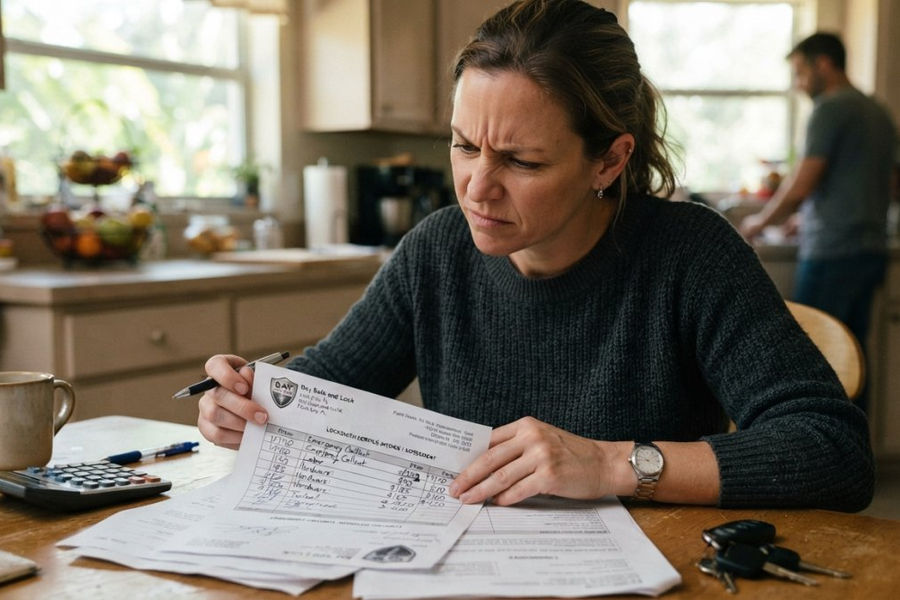
Watch for locksmiths who pressure you to pay cash only or who refuse to provide itemized invoices. Legitimate businesses accept multiple payment methods and provide documentation of charges. An invoice should list the service call fee, labor time and rate, materials used, and any surcharges.
Unsolicited calls offering locksmith services are almost always scams. If you didn't call them, they likely aren't a real locksmith service. Real locksmiths don't cold-call homes offering emergency services.
Another red flag: a locksmith who wants to replace your lock instead of opening it. Legitimate locksmiths can open most residential locks without damage. If replacement is truly necessary, they should explain why and provide options. If they immediately jump to "we need to drill it out and install a new lock," get a second opinion.
Watch Out If a locksmith arrives and immediately starts drilling or destructive entry without attempting non-destructive methods first, stop them and ask for an explanation. Damage-free entry is standard practice for professionals. Unnecessary destruction suggests either incompetence or intentional damage to inflate the bill.
Verifying Credentials and Licensing
Before calling, verify that a locksmith is licensed. Licensing requirements vary by state, but most states require locksmiths to be licensed and insured. Check your state's licensing board or the Better Business Bureau for verification.
Ask for proof of insurance when the locksmith arrives. Legitimate locksmiths carry liability insurance. If they can't provide proof, decline their services. Insurance protects you if something goes wrong.
Federal background checks are a mark of professionalism.
What to Ask a Locksmith Before They Arrive
Asking the right questions during your initial call prevents surprises and helps you identify legitimate professionals. These questions serve as a screening mechanism.
Emergency Lockout Service Duration and Response Times
Emergency response time varies based on location, time of day, and current demand. Understanding realistic timeframes helps you plan and avoid overpricing based on false urgency.
Understanding Your Invoice
Your invoice is your protection against overcharging. A legitimate invoice breaks down charges clearly so you understand what you're paying for.
Itemized Breakdown and Hidden Fees
A proper invoice lists:
Service call fee (the flat dispatch charge)
Labor time and hourly rate (or flat labor fee for the specific job)
Materials used (if any, keys, lock parts, etc.)
Any surcharges (after-hours, weekend, emergency)
Total amount due
Each line item should be clear. "Labor: $150" is acceptable if that was the quoted rate. "Miscellaneous charges: $200" is not. You should understand every charge.
Key Takeaway The difference between a fair locksmith and a scammer often comes down to transparency. Legitimate professionals provide clear pricing upfront, itemize invoices, and stand behind their rates. Scammers avoid these practices.
Insurance and Warranty Coverage
Ask whether a warranty applies to your job.
Insurance coverage matters if damage occurs during the work. Your homeowner's or business insurance might cover locksmith-related damage, but it depends on your policy. Some locksmiths carry insurance that covers accidental damage they cause. Verify this before work begins.
Frequently Asked Questions
What is a standard service call fee for emergency locksmith services?
Service call fees vary based on time of day, location, and lock complexity. Most locksmiths charge a dispatch or trip charge separate from labor costs. For emergency locksmith service pricing, fees are typically higher during nights, weekends, and holidays. Contact Bay Safe and Lock for a current quote tailored to your specific situation and property type.
How can I tell if a locksmith quote is legitimate?
A legitimate locksmith should provide an upfront estimate before beginning work, explain what's included in the service call fee, and show proof of licensing and insurance. Ask for references and verify credentials through your state's licensing board. Be wary of quotes that seem unusually low or locksmiths who pressure you into immediate payment without itemizing charges.
What factors influence the final cost of an emergency lockout service?
Key factors include the type of lock (residential deadbolt vs. commercial security hardware), time of day (after-hours surcharge), location and travel distance, lock complexity and manipulation difficulty, and whether hardware replacement is needed. Emergency response times and dispatch fees also affect pricing. Professional assessment on-site may reveal additional costs if rekeying or hardware replacement is necessary.
Does insurance typically cover emergency locksmith services?
Most homeowners insurance policies do not cover lockout services unless break-in or property damage occurred. Some renters insurance may include limited coverage. Check your specific policy terms and contact your insurance provider. Commercial property policies sometimes include emergency access services. Always ask your locksmith about warranty coverage on their work.
What should I ask a locksmith before they arrive to avoid surprises?
Ask for an estimated arrival time, confirm the service call fee structure, inquire about their hourly labor rate if applicable, request an upfront quote for the specific service needed, and ask whether additional charges may apply if the lock requires special techniques or hardware replacement. Also verify they're licensed, insured, and offer damage-free entry methods before authorizing work to begin.
NEED AN ESTIMATE FOR YOUR PROJECT? CLICK HERE


Comments