

Can You Open Antique Safes? A 2026 Guide
Updated: Sep 16
Table of Contents
Can You Open Antique Safes? Yes, Here's How
Non-Destructive vs. Destructive Entry Methods
Legal and Ethical Considerations Before You Start
Identifying Safe Types and Locking Mechanisms
Reading the Maker, Era, and Serial Number
Why the Mechanism Determines the Method
How to Find Safe Combination: Dialing Procedures and Manipulation
Dialing Sequence Mechanics Explained
Troubleshooting Common Dial Issues
Tools and Skills for Mechanical Safe Lock Repair
How Manipulation Actually Works
The Relocker Problem
Non-Destructive vs. Destructive: Choosing the Right Approach
When to Call for Antique Safe Locksmith Services
Risks of DIY Safe Cracking and Why Professionals Matter
Safe Appraisal, Historical Identification, and Maintenance After Opening
Frequently Asked Questions
Last Updated: September 12, 2026
Can You Open Antique Safes? Yes, Here's How
Can you open antique safes? Yes, in most cases an experienced technician can open an antique safe without destroying it, even when the combination has been lost for decades. At Bay Safe and Lock, we have opened everything from ornate brass-fitted Victorian-era strongboxes to heavy-duty early 20th-century security containers, and the same truth applies: the lock is mechanical, the mechanism follows predictable rules, and those rules can be worked.
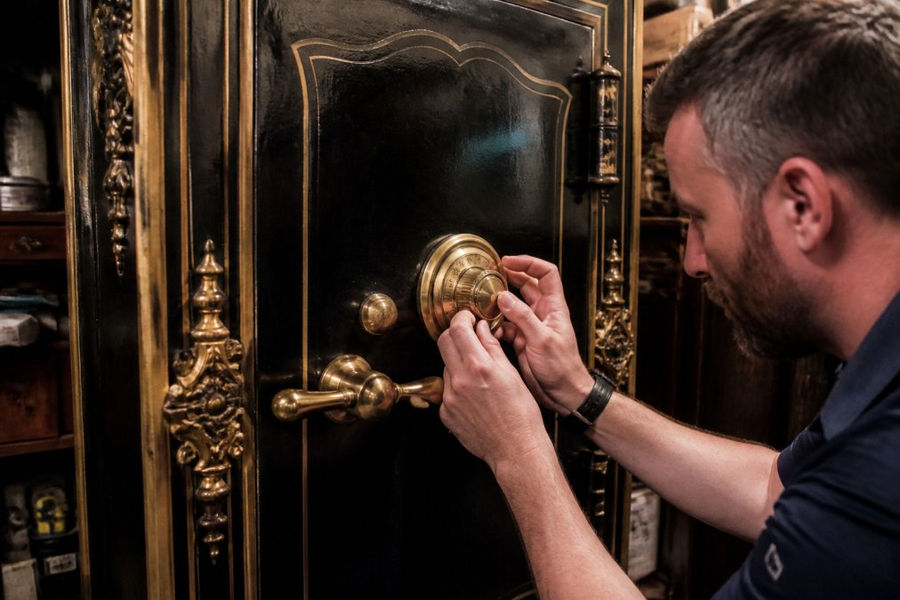
Age alone rarely makes a safe unopenable. The part most guides skip is the difference between a safe you can talk open and one you will ruin by trying.
Non-Destructive vs. Destructive Entry Methods
Non-destructive entry opens the safe without damaging the door, dial, or internal locking mechanism, using manipulation (reading the lock through feel and sound) or a careful bypass of the bolt work. Destructive entry involves drilling, cutting, or prying and leaves visible damage.
For antique safes, non-destructive methods are almost always the priority: the hardware is often irreplaceable, and a drilled hole in a century-old door can cut the safe's value dramatically. Drilling is not faster, a skilled technician often opens an old mechanical lock by manipulation in less time than it takes to set up a drill rig and patch the damage.
Watch Out Never force an antique dial past its natural stopping point. The wheel pack and spindle inside are often made of softer metals that bend instead of flex, and a forced rotation can shear the drive cam and turn a simple opening job into a full lock rebuild.
Legal and Ethical Considerations Before You Start
Only attempt to open a safe you can lawfully prove is yours or are authorized to access. Ownership matters especially with inherited safes where the original paperwork may be long gone.
Before any technician, including ours, touches a dial, expect questions about ownership, where the safe came from, and whether documentation exists. If you inherited a safe, gather whatever you have: a bill of sale, an estate document, a photo of the safe in its original location, or a statement from the previous owner. A locksmith who skips these questions entirely is a red flag.
Identifying Safe Types and Locking Mechanisms
The first practical step is identifying what you are dealing with, because the locking mechanism dictates the method. Antique safes generally fall into a few categories based on their lock and bolt work.
Single-dial mechanical combination locks: The most common type. You rotate one dial through a dialing sequence to align the internal wheel pack.
Dual-control or two-person locks: Two separate dials or a dial plus a key, common on bank and commercial safes.
Key-locking safes: Older models may use a key alone or a key combined with a dial.
Time locks: Found on some commercial antiques, these prevent opening until a set interval passes.
The locking mechanism is the internal assembly that holds the door shut: the wheel pack, the fence, the drive cam, and the bolt work extending into the frame. A safe technician reads the lock by listening for the faint click of the fence dropping into the wheel gates as the dial rotates.
Reading the Maker, Era, and Serial Number
Most guides stop at lock type. What actually changes how a safe is opened is who built it and when, because makers used different wheel-pack designs, spindle sizes, and relocker placements across eras. Before you touch the dial, look for these identifiers:
Manufacturer name or logo stamped on the door face, the dial ring, the bolt work, or the back of the door. Historic American makers include Mosler, Diebold, York, Cary, Herring-Hall-Marvin, and Victor, among others. A maker name narrows the mechanism family immediately.
Serial number, usually stamped on the door edge, the frame, or a small plate near the hinge. Serial ranges are the most reliable way to date a safe when the maker's records survive.
Patent dates cast or stamped into the lock or bolt work. A patent date is a hard floor on the manufacturing year and often points to a specific lock model (uspto.gov).
Dial style and finish. Early dials were often brass with engraved numerals; later production moved to painted or enameled faces. The dial ring, not just the dial, is a dating clue.
Door construction. Pre-1900 safes frequently used a single thick plate or a thin outer shell over a fire lining; later security containers added laminated plates and hardened drill-resistant layers.
Owners often assume an old-looking safe is valuable, but age and value are not the same thing. A plain early 20th-century commercial container may be worth far less than a smaller, ornately decorated safe from an earlier era with a documented maker. For a value estimate, gather the maker, serial number, patent dates, and clear photos of the door, dial, and any interior labels, then have a safe appraiser or knowledgeable technician review them.
Pro Tip Photograph every stamp, plate, and patent date before any work begins. If the safe is later moved, restored, or sold, those images are the only record of its original identity, and they help a technician match the lock to the correct manipulation method.
Why the Mechanism Determines the Method
Once you know the lock family, the opening method follows. A single-dial wheel-pack lock is a candidate for manipulation. A dual-control or time-lock safe usually is not, because the second control or timing mechanism blocks the bolt work regardless of the dial. A key-locking antique may open with a key alone, or the key may only release a cover over the dial. Misidentifying the type is the most common reason a careful owner spends hours dialing a lock that was never going to respond.
How to Find Safe Combination: Dialing Procedures and Manipulation
Learning how to find a safe combination on an antique mechanical lock starts with understanding that the combination was never stored in the safe; it lives in the positions of the wheels inside the lock. If the original combination is lost, a technician recovers it through manipulation.
Dialing Sequence Mechanics Explained
A mechanical combination lock rotates a stack of wheels, called the wheel pack, using the dial and spindle. Each wheel has a notch, or gate, cut into its edge. Dialing a number positions one wheel; when all the gates line up under the fence, the fence drops in, the drive cam releases, and the bolt work retracts so the door can open.
Dialing follows a strict pattern: turn several full rotations clockwise to clear the wheels, stop on the first number, reverse past the first number once and stop on the second, reverse again for the third, and so on. The final turn retracts the bolt. Get the direction or number of passes wrong and the wheels never align.
Troubleshooting Common Dial Issues
When a dial fights back, the problem is usually mechanical, not user error. Here is how to read the symptoms.
Symptom | Likely Cause | What It Means |
Dial spins freely with no resistance | Broken spindle or drive cam | Lock internals have failed; manipulation will not work |
Dial sticks or grinds | Worn wheel pack or debris | Needs cleaning or professional service |
No clicking noise at contact points | Fence not engaging wheels | Lock may need repair before opening |
Dial stops short of a number | Bent spindle or misaligned wheel | Forcing it will cause more damage |
Combination worked before, now it doesn't | Wheel slipped or worn gates | Re-manipulation or lock service required |
If the dial gives no feedback at all, stop. A dead dial usually means the lock has already failed internally, and no amount of dialing will open it.
Pro Tip On many antique safes, the contact points, the faint clicks you feel as the fence touches each wheel, are your best map to the combination. A technician marks each contact point, then calculates the gates from the spacing between them. This is why patience beats force every time.
Tools and Skills for Mechanical Safe Lock Repair
Mechanical safe lock repair requires a specific set of tools and, more importantly, the skill to use them without causing damage. The toolkit is not exotic, but the technique is where most DIY attempts fail.
A safe technician typically works with:
A stethoscope or electronic amplifier to hear the fence contact the wheels.
Manipulation aids such as a dialing chart to record contact points.
A borescope to inspect the lock interior through a small, clean opening when needed.
Precision hand tools for removing the back cover or dial assembly on serviceable models.
Drilling equipment reserved for last-resort destructive entry, used only when non-destructive methods fail.
Skill matters more than tools. Reading a mechanical lock is a learned feel built over hundreds of openings: manipulation is not brute force but careful measurement of tiny resistance changes as the dial rotates.
How Manipulation Actually Works
Manipulation is the non-destructive technique of recovering a combination by feel and sound rather than drilling. The process follows a repeatable logic:
Clear the wheels. Turn the dial several full rotations in one direction to reset the wheel pack to a known position.
Find the contact points. Rotate slowly and note each point where resistance changes or a faint click is felt. Each contact point corresponds to a wheel position.
Graph the readings. Record every contact point across multiple passes. The spacing between contact points reveals the relationship between the wheels.
Calculate the gates. The gates are the notches cut into each wheel. By comparing contact-point spacing, a technician narrows each wheel's gate to a small set of candidate numbers.
Test and confirm. Dial the candidate combination, adjusting one wheel at a time until the fence drops into all gates and the bolt work retracts.
Patience beats force every time. A three-wheel pack has a huge number of theoretical combinations, but the contact points reduce the real search to a manageable set (nist.gov). A technician is not guessing; they are measuring.
The Relocker Problem
Many antique and early modern safes include a relocker, a secondary bolt held back by a spring or glass plate. If the lock is disturbed, drilled, or the dial is forced, the relocker fires and seals the door shut. Once engaged, even a professional faces a much harder job, often requiring precise drilling at a known location to reset it (savta.org). This is the strongest argument for calling a technician before you experiment: a minor mistake can turn a routine opening into a major repair.
Watch Out Never drill an antique safe to "see what's inside." A blind hole can miss the lock entirely, punch through the door into the contents, or trip a relocker. On a safe with irreplaceable hardware, a wrong hole can cut the value dramatically and may not even open the door.
Non-Destructive vs. Destructive: Choosing the Right Approach
The decision between non-destructive and destructive entry is the one most owners get wrong. Non-destructive entry, manipulation or a careful bypass of the bolt work, preserves the door, dial, and lock. Destructive entry, drilling, cutting, or prying, leaves visible damage that must be repaired, and on an antique the repair may be impossible to match.
Destructive entry is reserved for cases where the lock has already failed internally, a relocker has fired, or the safe is a low-value container and the owner has approved the trade-off. For an heirloom or collectible, non-destructive is almost always the priority, and the extra time is worth it.
When to Call for Antique Safe Locksmith Services
Call an antique safe locksmith service when the safe is valuable, the dial gives no feedback, or your first careful attempts fail. Antique safes are not the place to learn by trial and error.
Here is when professional help is the right call:
The safe is an heirloom, has historical value, or shows ornate craftsmanship.
The dial is dead, stuck, or grinding.
You have tried the standard dialing procedure and gotten nowhere.
The safe contains documents or items you cannot risk damaging.
You are unsure of ownership or legal right to open it.
A licensed, insured technician brings the tools, the experience, and the accountability. Bay Safe and Lock's team is licensed, fully insured, and Federal level 2 background checked, and we handle specialized safe opening and custom fabrication for residential, commercial, and industrial clients. That matters when the safe in front of you cannot be replaced.
Risks of DIY Safe Cracking and Why Professionals Matter
DIY safe cracking carries real risks, and the biggest one is not failure but success that damages the safe: you might get the door open and still destroy the lock, bolt work, or door finish.
The specific dangers include:
Shearing the drive cam by forcing the dial, which can lock the safe permanently.
Bending the spindle, which misaligns the entire wheel pack.
Drilling in the wrong spot, which misses the lock and punches through the door or the contents.
Triggering a relocker, a security feature on many safes that fires a secondary bolt if the lock is tampered with, sealing the safe shut.
Safe Appraisal, Historical Identification, and Maintenance After Opening
Once an antique safe is open, two things are worth doing: identifying what you have and keeping it functional.
For identification, look for the manufacturer's name, serial number, and patent dates stamped on the door, dial, or bolt work. These details help date the safe and point to its maker and model, and a safe appraiser or knowledgeable technician can estimate its historical and market value. Some antique safes are worth far more as collectibles than as storage.
For maintenance, a mechanical safe needs little, but it needs it regularly:
Have the lock cleaned and lubricated by a technician every few years.
Keep the dial and spindle free of grit and moisture.
Record the combination in a secure place once it is recovered.
Avoid slamming the door, which stresses the bolt work.
Store the safe in a space with stable temperature and low humidity to prevent rust.
Antique restoration is a specialty, and the wrong lubricant can gum up a century-old lock. Let a professional handle the internals.
Opening an antique safe is entirely possible, but it rewards patience and punishes guessing. The dial, wheel pack, and bolt work follow mechanical rules you can work with, and a skilled technician can open most antique safes without leaving a mark. If you have an inherited safe, a lost combination, or a dial that has gone silent, Bay Safe and Lock can help. Our licensed, insured, Federal level 2 background checked team brings over a decade of hands-on experience to specialized safe opening, mechanical safe lock repair, and custom fabrication. Get started with Bay Safe and Lock and open your antique safe safely, without destroying the history inside it.
Frequently Asked Questions
How do I open an old antique safe without the combination?
Opening an antique safe without a combination requires specialized knowledge. A locksmith will first identify the safe type and locking mechanism, then use techniques like lock manipulation or dialing procedures. For mechanical safes, they may listen for clicking noises and feel for contact points while rotating the dial clockwise and counterclockwise. Non-destructive entry is preferred to preserve the safe's integrity. If manipulation fails, drilling may be necessary, but this should only be done by a professional to avoid damaging the bolt work or wheel pack.
Can a professional locksmith open an old safe without damaging it?
Yes, experienced locksmiths can often open antique safes without damage using non-destructive methods. They employ techniques like manipulation, which involves feeling and listening to the lock's internal components, or scoping, which uses a borescope to view the mechanism. If drilling is required, it is done precisely at specific points to minimize harm, and the safe can usually be repaired afterward. However, success depends on the safe's condition and the locksmith's skill. Always hire a licensed and insured professional to protect your safe's value.
Are antique safes worth anything if they are locked?
Locked antique safes can still hold significant value, especially if they are from renowned makers or feature unique craftsmanship. The locking mechanism itself, such as an old mechanical safe lock, may be of interest to collectors. However, a locked safe with an unknown combination or lost key may be valued lower because of the cost and effort to open it. For an accurate appraisal, consult a safe technician or antique specialist who can assess the safe's condition, historical identification, and potential restoration costs.
What are the risks of trying to force open an antique safe?
Forcing open an antique safe can cause irreversible damage to the safe door, bolt work, and locking mechanism. It may also destroy the safe's historical value and integrity. DIY attempts with drills, pry bars, or cutting tools can lead to injury and costly repairs. Additionally, you could damage the contents if the safe contains documents or delicate items. Always seek antique safe locksmith services to ensure non-destructive entry when possible and to maintain the safe's worth.
NEED AN ESTIMATE FOR YOUR PROJECT? CLICK HERE

Comments